
robot-dev-team
Robot Dev Team is a containerized FastAPI service that enables Bring Your Own Agents (BYOA) to GitLab by consuming GitLab webhooks, enriching events with CLI tools, and dispatching context-rich prompts to any CLI-based LLM agent via YAML routing rules.
Ficha actualizada 23 sept 2026, 14:07 · upstream 23 sept 2026, 13:57 · release sin release detectada
Qué es robot-dev-team
Descripción editorial construida a partir del repositorio, su documentación y sus señales de mantenimiento.
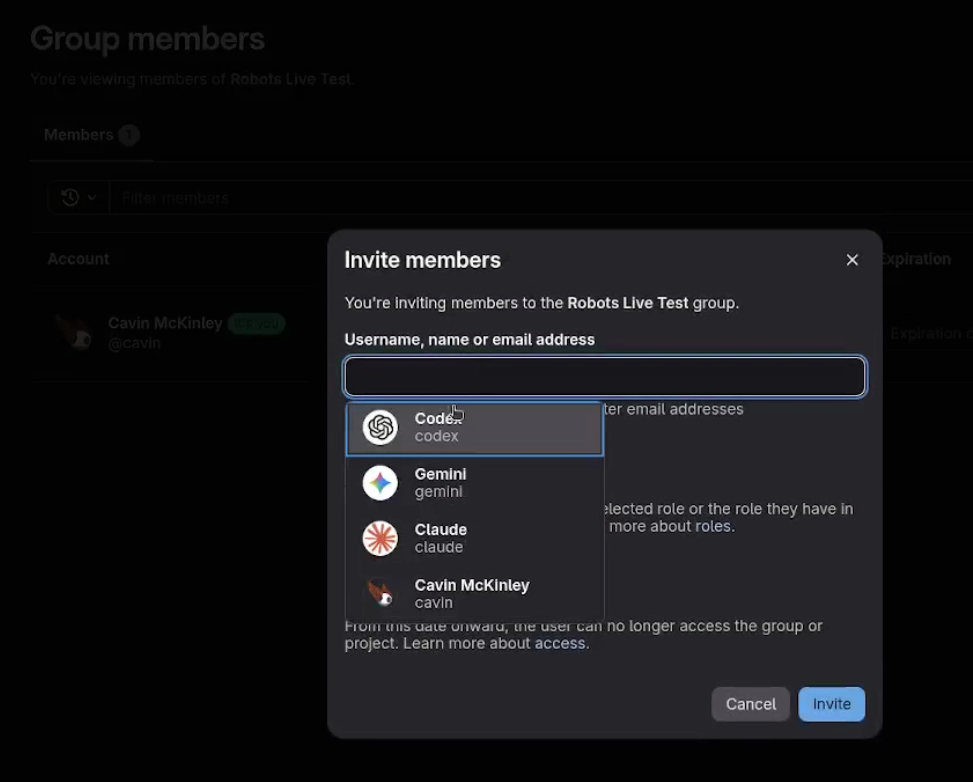
Robot Dev Team provides an agent orchestration platform where developers can bring their own AI agents into a GitLab environment. The service acts as a central router that receives GitLab webhooks triggered by repository events, enriches the context with relevant information from the GitLab CLI (such as issue details, merge request diffs, and branch information), and then dispatches these enriched prompts to any agent running on your system. This approach eliminates the need for separate API keys or dedicated infrastructure for each AI provider, allowing you to leverage existing command-line tools like Claude Code, Google Gemini, OpenAI Codex, or any other CLI-based LLM agent.
- Automated code review and PR feedback where multiple agents collaborate on the same issue
- Parallel processing of different aspects of a development task using specialized agents for each sub-task
- Multi-agent collaboration workflows where distinct agents handle different roles (e.g., writer, reviewer, tester) within a single project
- Context-aware agent routing that directs specific GitLab events to the most appropriate agent based on event type and content
- Centralized agent management with unified authentication across multiple AI providers without managing separate API keys
- BYOA architecture allows mixing and matching different LLM agents (Claude, Gemini, Codex) within a single GitLab project without platform lock-in
- GitLab CLI tools are integrated directly into the agent orchestration pipeline, enabling rich context enrichment from issues, MRs, and comments at no additional cost
- Docker containerization provides complete isolation between agents, allowing each to run in YOLO mode with minimal resource overhead
- Template-based prompt injection allows dynamic generation of task prompts using real-time GitLab data (issue body, branch info, merge request diff)
- Live streaming dashboard enables real-time monitoring of agent stdout, thinking processes, and system logs through WebSocket connections
- Requires a self-hosted GitLab instance with webhook configuration; no native integration with GitHub or other platforms
- Agent CLI tools must be installed on the host machine and authenticated locally before deployment
- Docker volume mounts for projects require local disk space and proper permissions on the host system
- No built-in agent memory or state persistence between runs without additional configuration
- Routing rules are static YAML files that cannot dynamically adapt to changing project structures
Capturas del proyecto
Imágenes reales detectadas en la documentación del repositorio.

Perfil de infraestructura
Estimación inicial derivada del repositorio y de los servicios detectados.
Despliegue detectado
Qué señales reales de instalación hemos encontrado.
Deploy using Docker Compose with a single `docker-compose.yml` file. Set the GitLab webhook URL in `.env` and configure your GitLab instance to send webhooks to `http://localhost:8080/webhooks/gitlab`. For multi-project setups, mount project directories as volumes (e.g., `./projects:/work/projects`) so agents can clone repositories on-demand. Use `ENABLE_AUTO_CLONE=true` in `.env` for automatic repository cloning from GitLab events. Set `DEBUG_RELAY=true` to enable debug relay mode for local development and testing.
Stack y dependencias
Componentes inferidos a partir de manifests, configuración y documentación.
Puede sustituir a
Relaciones detectadas por el análisis del repositorio y su categoría.
Experiencia real de la comunidad
Ayuda a contrastar la estimación automática con instalaciones reales.
Todavía no hay datos comunitarios para este proyecto.