
qualytics-self-hosted
Qualytics Self-Hosted is a container-native platform for assessing, monitoring, and facilitating enterprise data quality. It runs on Kubernetes with support for JDBC connectors (Snowflake, BigQuery, Redshift, etc.) and DFS connectors (S3, GCS, Azure Data Lake).
Ficha actualizada 23 sept 2026, 17:10 · upstream 23 sept 2026, 16:49 · release qualytics-2026.9.23
Qué es qualytics-self-hosted
Descripción editorial construida a partir del repositorio, su documentación y sus señales de mantenimiento.
Qualytics is a closed-source container-native platform designed to assess, monitor, and facilitate enterprise data quality across distributed systems. The chart deploys a single-tenant instance of the platform onto a CNCF-compliant Kubernetes control plane. The architecture consists of three node groups: Application Nodes (API server, CMD service, Frontend UI), Spark Driver Nodes (single driver pod that creates executor pods dynamically based on workload demand), and Spark Executor Nodes (dynamic executors created by the driver). Datastores are configured externally via JDBC or DFS connectors, with metadata connections opened by the driver and parallel reads performed by executors. The platform supports autoscaling for application nodes, dynamic scaling of spark drivers and executors, and can run on any Kubernetes infrastructure including AWS EKS, GCP GKE, Azure AKS, or bare-metal.
- Monitor data quality across multiple sources (Snowflake, BigQuery, Redshift, Databricks, PostgreSQL, Oracle, SQL Server) in a single platform
- Automatically detect and alert on data anomalies, missing values, duplicates, and format inconsistencies
- Facilitate data governance by providing dashboards for data quality metrics and compliance reporting
- Support real-time monitoring of data pipelines with Spark-based processing and dynamic scaling
- Enable self-service data quality workflows where teams can define rules without code changes
- Integrate with existing data infrastructure (AWS S3, GCP Storage, Azure Data Lake) for comprehensive coverage
- Fully container-native deployment on Kubernetes with CNCF certification compliance
- Supports up to 10 TB of data under management with configurable cluster tiers
- Dynamic Spark executor scaling (1–12 executors per driver pod) for optimal resource utilization
- Database-backed authentication with OpenID Connect and SAML 2.0 provider integration
- Terraform templates available for AWS EKS, GCP GKE, and Azure AKS infrastructure provisioning
- Supports both JDBC and DFS connector families (Snowflake, BigQuery, Redshift, Databricks, S3, GCS, Azure Data Lake)
- Closed-source platform with no public API or SDK for third-party integration
- Requires Kubernetes cluster version 1.30+ and Helm CLI 3.12+
- Authentication via database providers requires manual setup of identity provider (OIDC/SAML) after installation
- No built-in data lineage tracking; external tools must be used to map source systems
- Spark executor nodes are not autoscaled independently from the driver node group
- External PostgreSQL StatefulSet is only available when explicitly configured in values.yaml, otherwise defaults to in-cluster deployment
Capturas del proyecto
Imágenes reales detectadas en la documentación del repositorio.
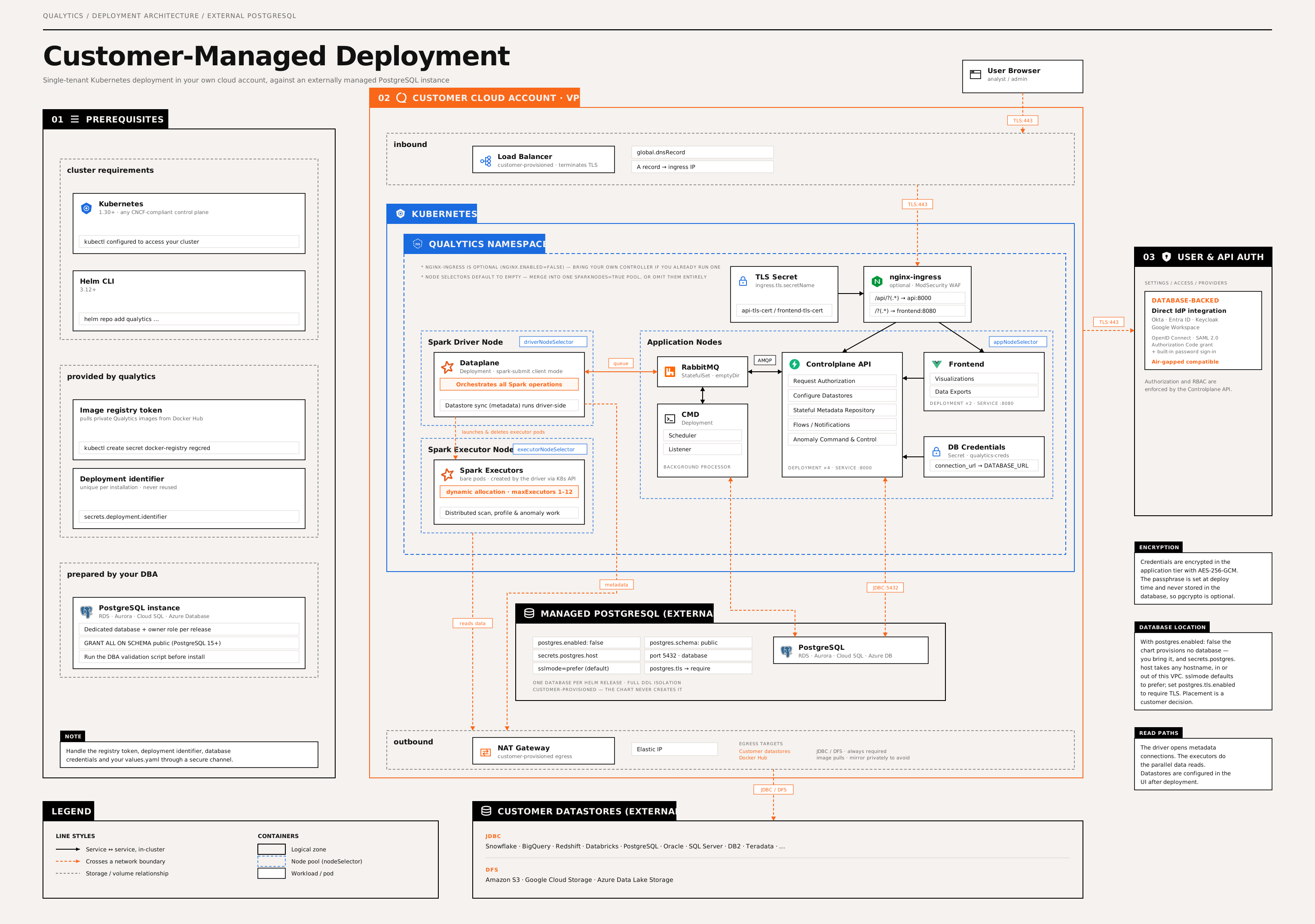
Perfil de infraestructura
Estimación inicial derivada del repositorio y de los servicios detectados.
Despliegue detectado
Qué señales reales de instalación hemos encontrado.
Deploy Qualytics using Helm on a CNCF-compliant Kubernetes cluster. Install the chart with the provided image registry token and unique deployment identifier. Configure DNS records for your domain (e.g., your-company.qualytics.io). Choose authentication via database providers or Auth0 integration. For production deployments, use Terraform templates to provision EKS/GKE/AKS clusters with appropriate instance types. Monitor pod health using `kubectl get pods -l app=qualytics` and ensure all driver and executor pods are running before initiating data ingestion workflows.
Stack y dependencias
Componentes inferidos a partir de manifests, configuración y documentación.
Puede sustituir a
Relaciones detectadas por el análisis del repositorio y su categoría.
Experiencia real de la comunidad
Ayuda a contrastar la estimación automática con instalaciones reales.
Todavía no hay datos comunitarios para este proyecto.