
Cmdarr
Cmdarr is a modular command-driven automation platform for self-hosted music workflows that integrates Lidarr, Plex, Jellyfin with Last.fm, MusicBrainz, and Spotify.
Ficha actualizada 23 sept 2026, 18:12 · upstream 23 sept 2026, 18:08 · release sin release detectada
Qué es Cmdarr
Descripción editorial construida a partir del repositorio, su documentación y sus señales de mantenimiento.
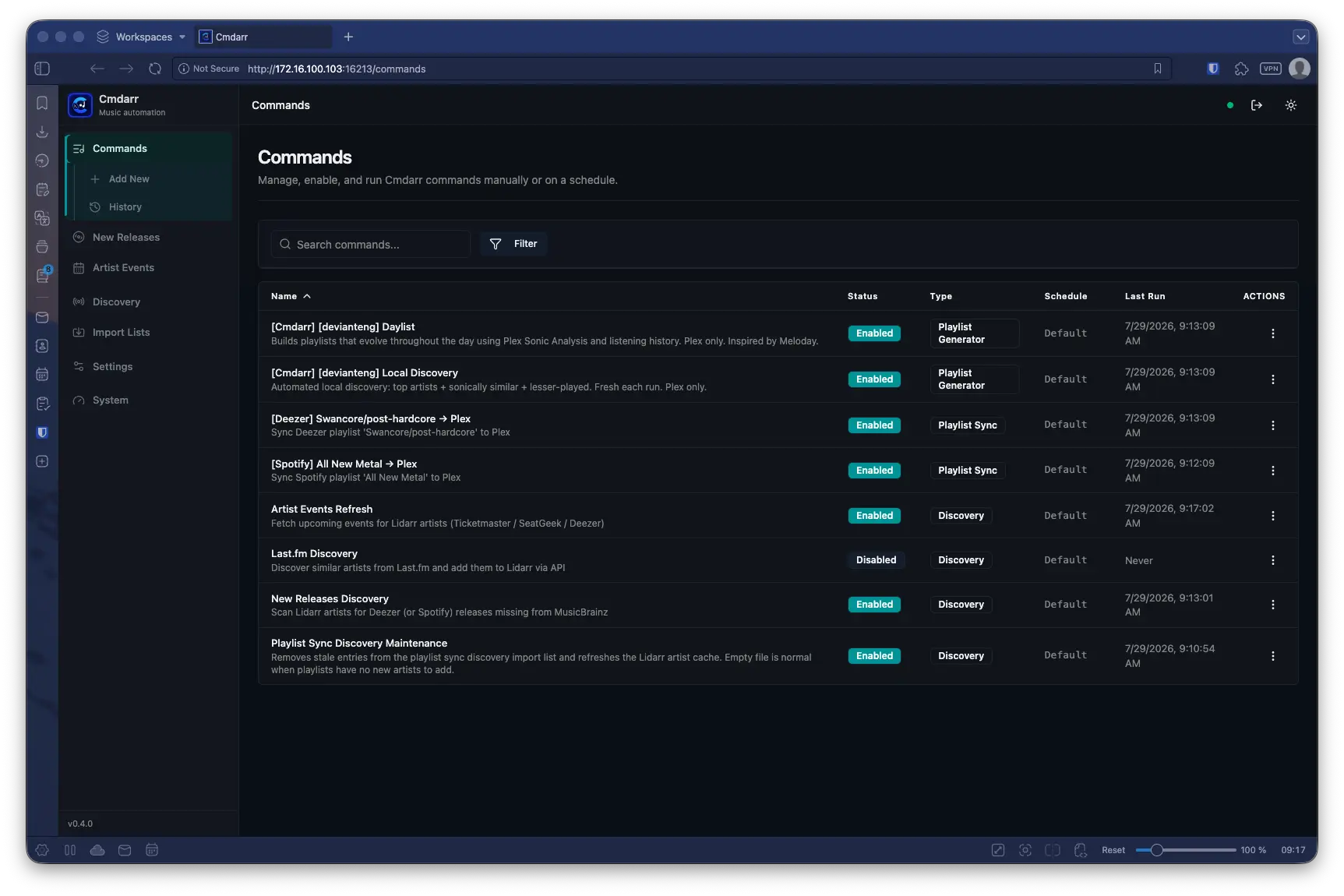
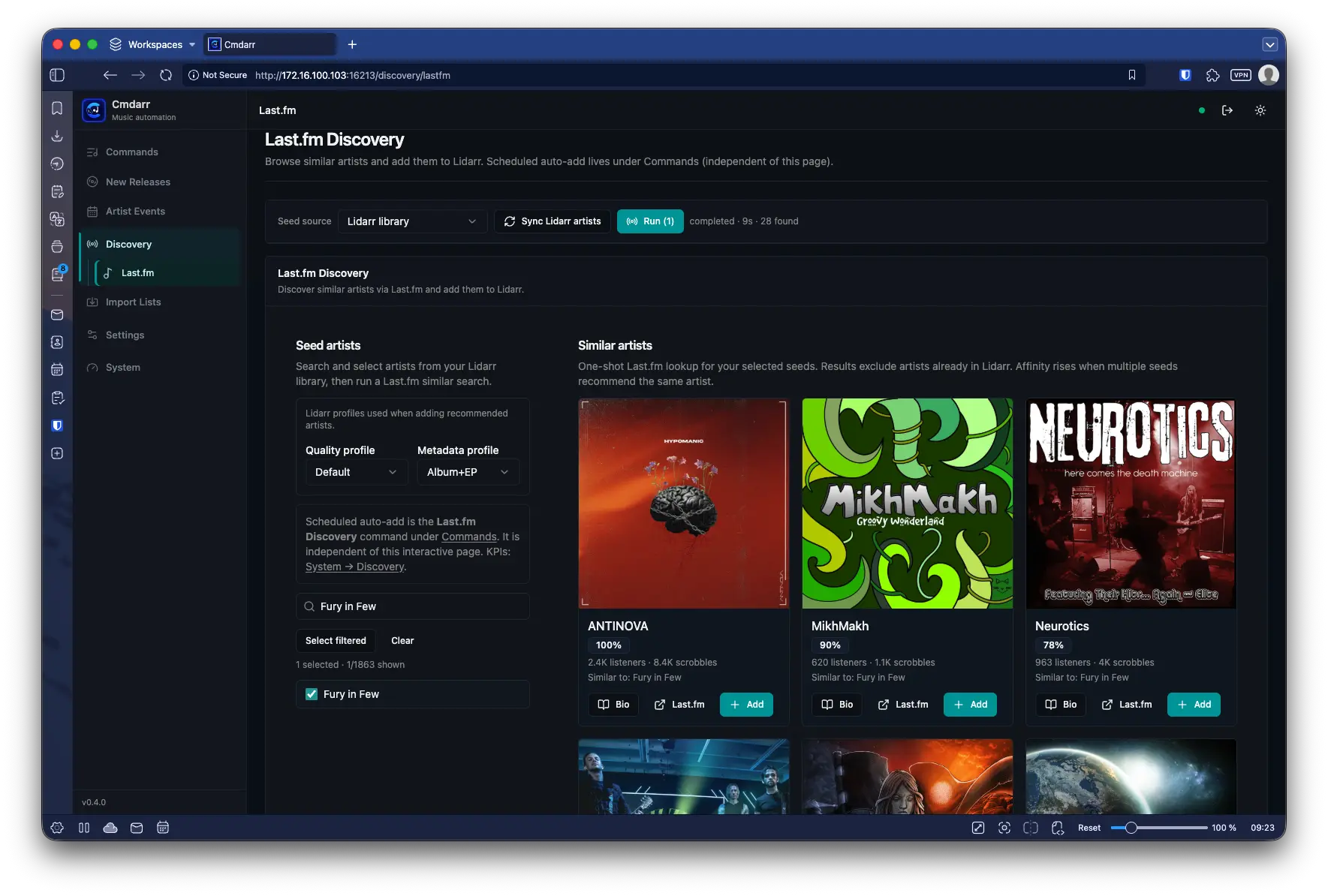
Cmdarr serves as the orchestration layer around Lidarr, enabling users to discover artists through interactive Last.fm discovery pages, sync playlists across platforms like Spotify, Deezer, and ListenBrainz into their media servers (Plex or Jellyfin), and surface upcoming artist events. The platform is built on a modular architecture allowing new commands to be added for different music services without modifying the core engine. It provides a web-based interface for managing automation tasks, viewing command history, and monitoring system health.
The tool addresses common pain points in home theater setups by eliminating manual scripting of playlist generation, artist discovery, and event tracking. Instead of relying on one-off scripts that are easily forgotten or misconfigured, Cmdarr offers a persistent, web-accessible dashboard where all automation tasks can be scheduled, monitored, and executed with full visibility.
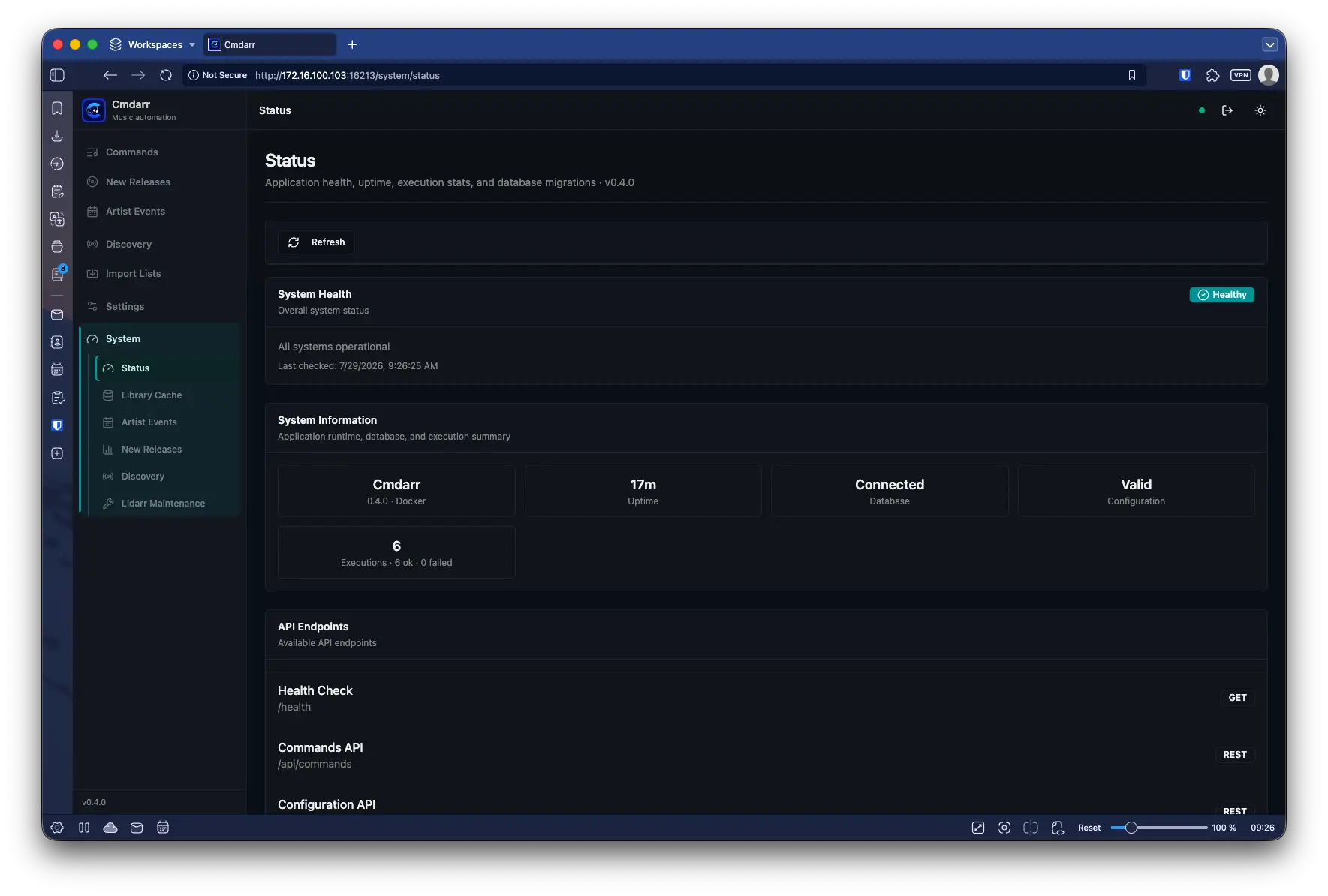
Beyond music-specific features, Cmdarr includes system-level capabilities such as library cache management for Lidarr metadata synchronization, optional authentication via API keys to protect sensitive credentials, and comprehensive health checks that alert administrators if the orchestration layer itself encounters issues. The platform is designed to be extensible through a modular command structure, making it suitable for both hobbyists setting up their first automation system and more advanced users who need to extend functionality.
The architecture separates concerns between the backend API (FastAPI with Python), the frontend React application, and the Lidarr integration layer. This separation allows independent scaling of components while maintaining a unified user experience through a single web interface. The use of Docker containers with proper security hardening (capability dropping, privilege escalation prevention) ensures that the automation platform remains secure even when running in an untrusted environment.
Users benefit from a consistent command-line interface pattern across all music services, reducing cognitive load and minimizing configuration errors. The platform also supports batch operations for new releases discovery a
- Automate playlist generation by syncing Spotify, Deezer, and ListenBrainz curated playlists into Plex or Jellyfin
- Discover new artists through interactive Last.fm pages without manual scripting
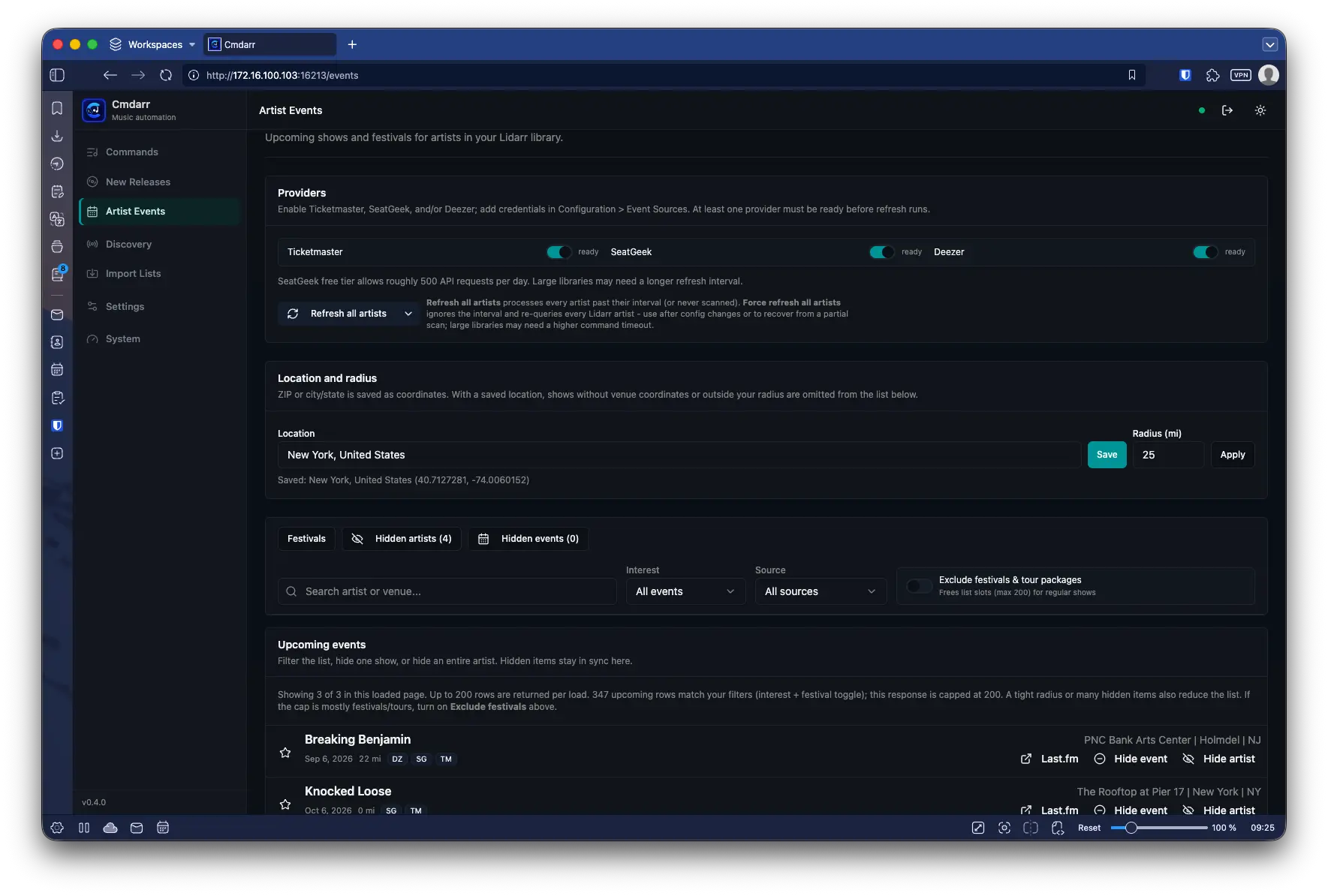
- Surface upcoming artist events (concerts, festivals) via Ticketmaster, SeatGeek, or Deezer feeds
- Trigger Lidarr maintenance tasks such as Update All metadata refresh and Wanted Search operations on a schedule
- Create custom playlist generators like Daylist, Local Discovery, Artist Essentials, or Mood for Plex Sonic
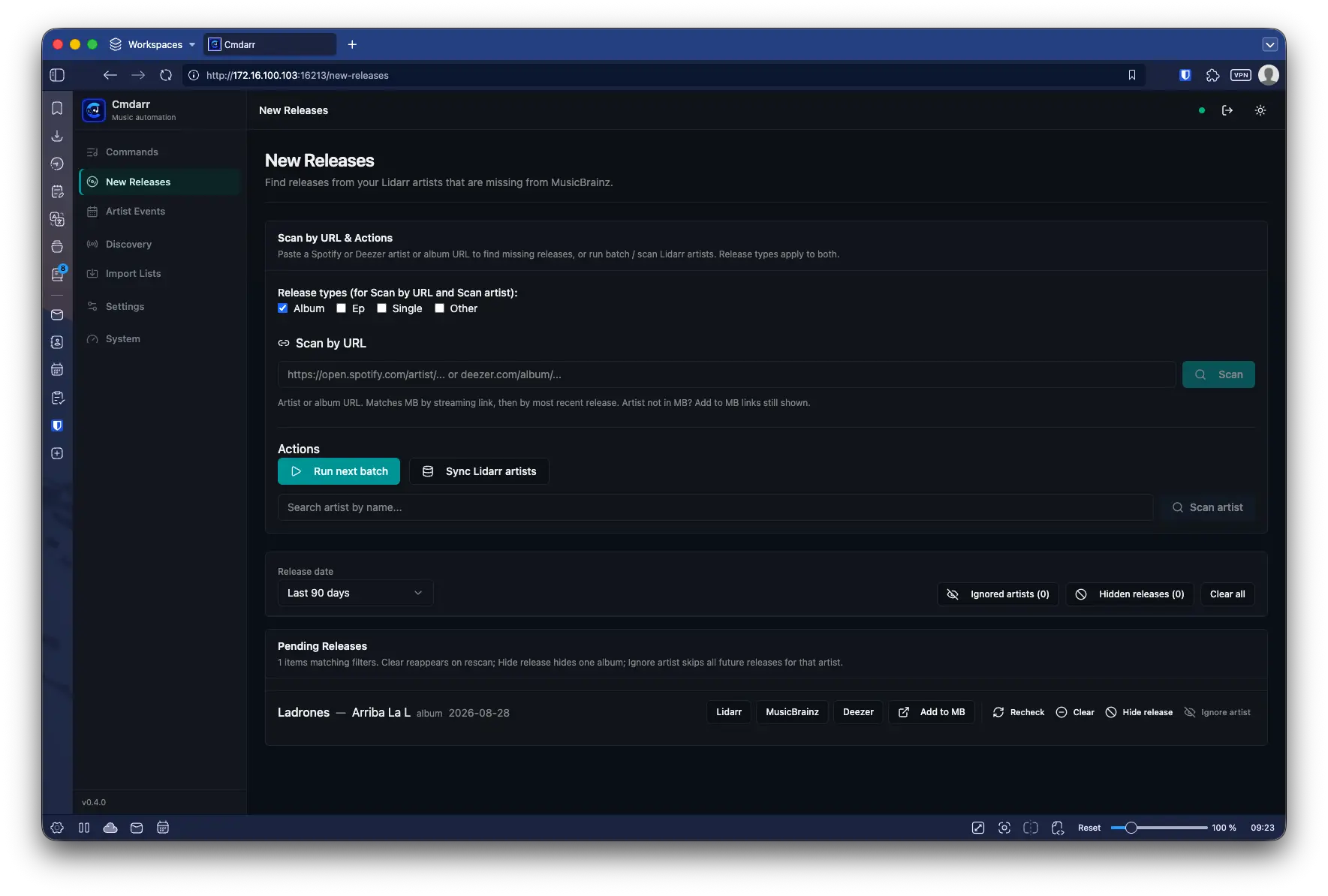
- Automatically add new releases from Deezer or Spotify that are missing in MusicBrainz to your library
- Monitor Lidarr health through system status checks and cache performance metrics
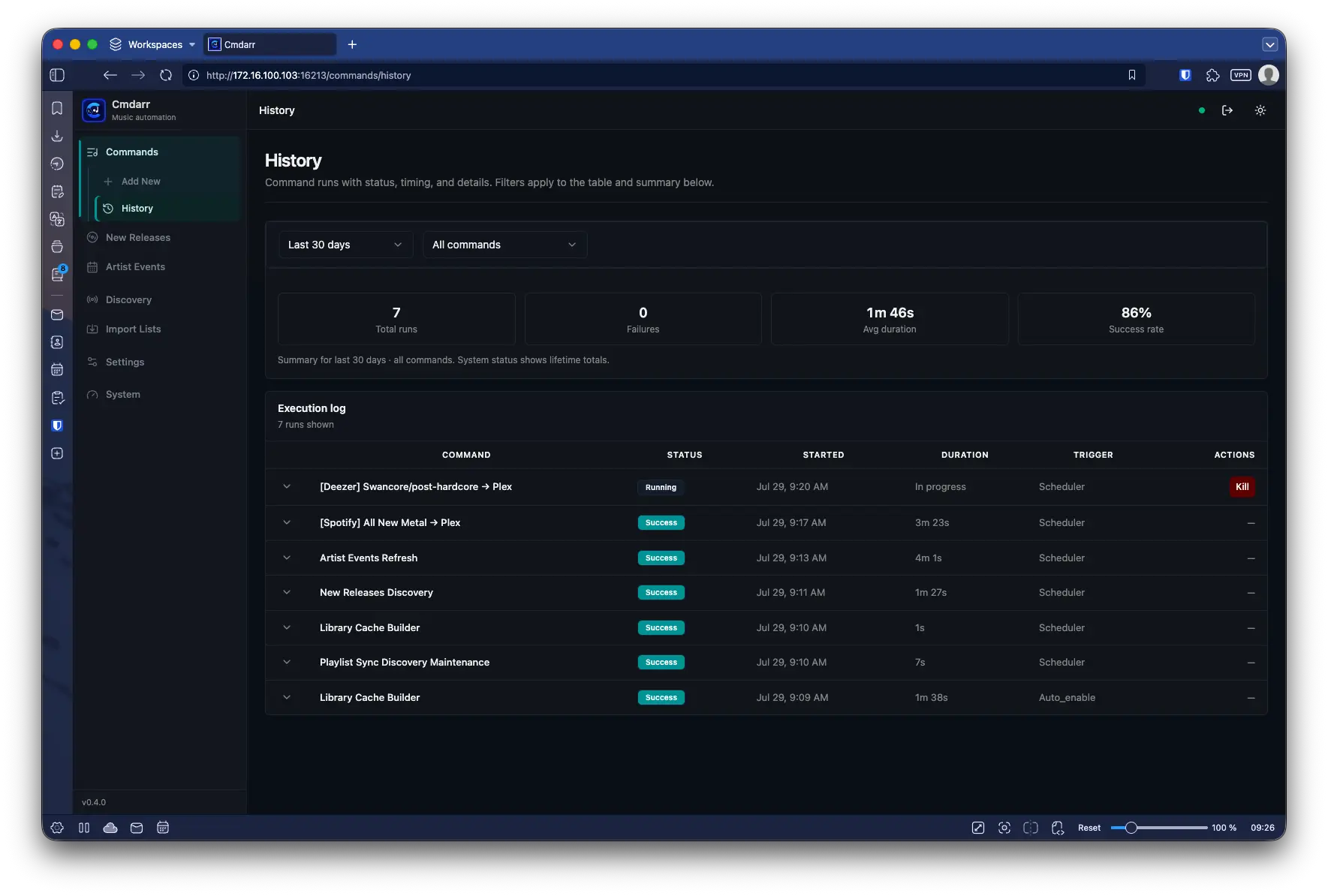
- Store automation command history for audit purposes and troubleshooting future issues
- Modular architecture allows adding new music service integrations without modifying the core engine
- Web-based dashboard provides a unified interface for all automation tasks, eliminating scattered scripts
- Last.fm discovery offers interactive UI with scheduled add-to-Lidarr functionality
- Supports batch scanning of new releases from Deezer and Spotify via MusicBrainz integration
- Includes system health monitoring with cache performance tracking to prevent Lidarr degradation
- Docker Compose deployment enables easy self-hosting with built-in security hardening (no root privileges)
- Optional authentication layer protects sensitive credentials like API keys and server tokens
- Requires Docker or Python 3.14 + Node 24 for local development; otherwise must use Docker Compose
- Last.fm discovery requires an interactive Last.fm account to create similar-artist pages
- New Releases batch scans depend on MusicBrainz being enabled and properly configured in Lidarr
- Setlist generator functionality depends on setlist.fm API availability, which may not be supported by all artists
- Playlist sync requires Plex or Jellyfin to be running; no support for other media servers like Emby
- Authentication via API keys is optional and does not provide full access control (no role-based permissions)
- No built-in scheduling beyond cron-like command execution; scheduled tasks must be manually triggered
Capturas del proyecto
Imágenes reales detectadas en la documentación del repositorio.
Perfil de infraestructura
Estimación inicial derivada del repositorio y de los servicios detectados.
Despliegue detectado
Qué señales reales de instalación hemos encontrado.
Deploy Cmdarr using Docker Compose with the provided YAML configuration. The container runs on port 8080 and exposes Lidarr at http://localhost:8686 via environment variable. For production, consider replacing ghcr.io/devianteng/cmdarr:latest with a custom image built from your own Dockerfile, implementing proper network policies to isolate the automation layer from other services, and configuring Redis for caching library metadata if you plan to scale beyond a single instance. Always set TZ=America/New_York in environment variables since Lidarr's Update All command is time-sensitive. Use the web UI for all configuration changes rather than editing Docker Compose files directly. Enable health checks with appropriate timeouts (10s) and retries (3) so that failed commands do not leave Cmdarr in an inconsistent state. For local development, ensure you build the React frontend first using
Stack y dependencias
Componentes inferidos a partir de manifests, configuración y documentación.
Puede sustituir a
Relaciones detectadas por el análisis del repositorio y su categoría.
Experiencia real de la comunidad
Ayuda a contrastar la estimación automática con instalaciones reales.
Todavía no hay datos comunitarios para este proyecto.